
Cheițele comunității: ediție specială cu Raluca Neagu și Teodora Cosac ✨
Special edition of Community ties — secrets of a thriving online community empowered by craft.

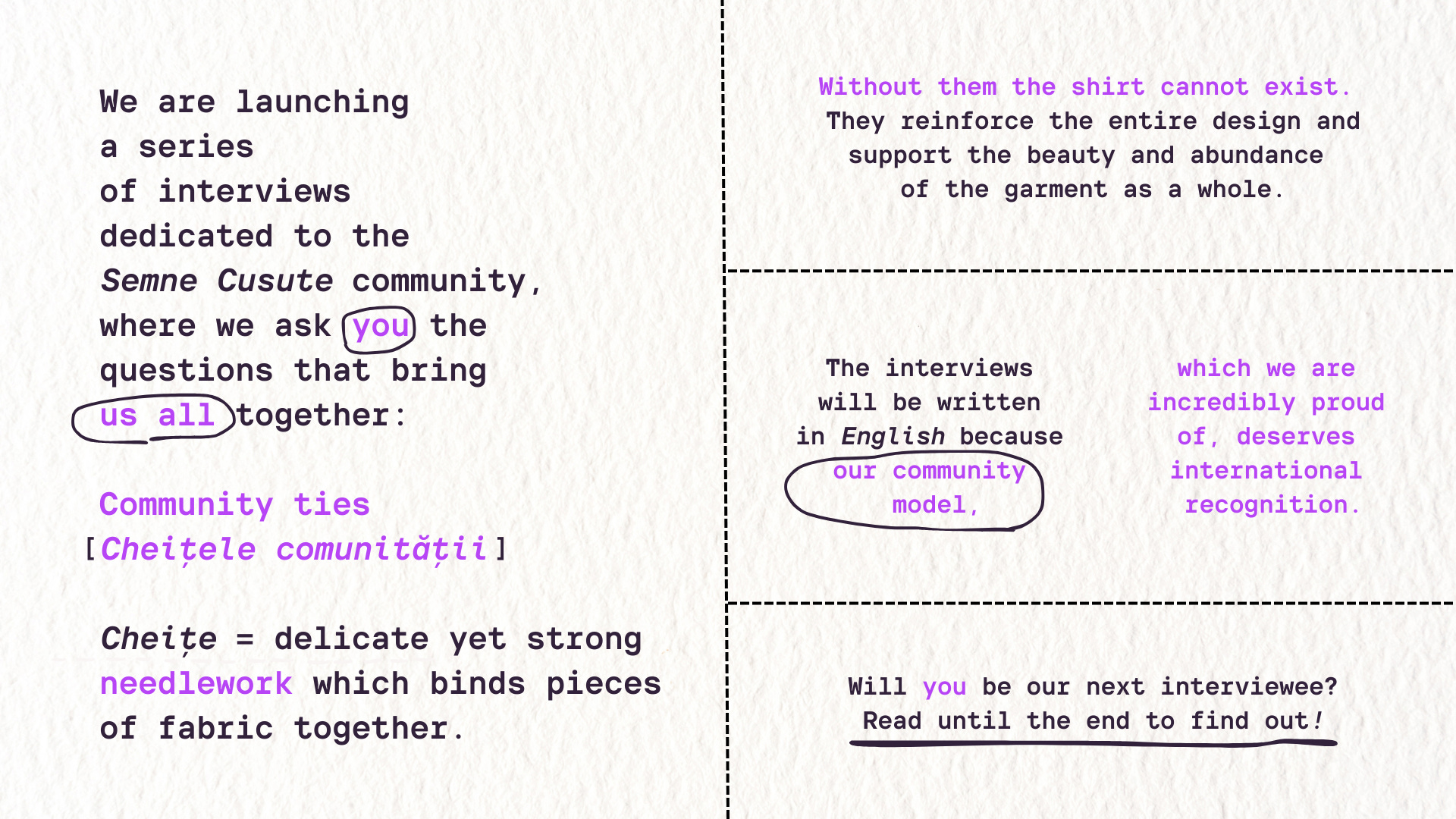
Aceasta este noua serie de interviuri dedicate comunității Semne Cusute, în care vă adresăm vouă întrebările care ne aduc pe toate împreună: cheițele comunității. Sunt cusăturile fine dar ferme, care leagă bucățile de pânză împreună. Fără ele, nu poate exista cămașa. Ele dau putere întregului croi. 💪
Interviurile vor fi redactate în engleză deoarece modelul nostru, cu care ne mândrim tare mult, merită să fie recunoscut la nivel internațional.
Data trecută, am stat de vorbă cu doamna Narcisa Razma Apostol, care ne-a transmis o dublă recomandare — așa că am decis să revenim cu o ediție mai deosebită…
🪡 Acestea fiind spuse,
vă invităm să stăm de vorbă cu doamnele Raluca Neagu și Teodora Cosac. Credeți că puteți ghici ce semn cusut le unește? Aflați răspunsul la final de tot.
1. What is your relationship with embroidery or with other forms of needlework from the country you have moved to?
Teodora Cosac: Since moving to Canada thirty years ago, I’ve discovered how many embroidery and textile traditions exist here. Canada is a country of immigrants, so people from all over the world have brought their own stitches, motifs, and styles. I’ve seen Ukrainian cross-stitch in their vyshyvanka – a close relative of our Romanian shirts - Italian lace, South Asian bead and sequin embroidery, and numerous quilting traditions from different parts of the world.
Most importantly, Indigenous beadwork and weaving are deeply respected and integral part of this country’s culture. Each tradition has its own look and meaning, but they all share the same patience, care, and storytelling that immigrants brought from their homelands. My relationship with embroidery has deepened because I keep learning from this variety.
For me, embroidery in a country like Canada feels like a meeting place. Even though the styles are very different, the love for meticulous needlework and the meaning behind each design are the same everywhere. I feel a sense of connection when I see these traditions, because it reminds me that embroidery is not just about decoration — it is about keeping culture alive. Living here, I have come to appreciate how my Romanian embroidery can stand alongside other traditions and add to the mix that makes up Canada’s cultural identity.
Raluca Neagu: Since moving to France, to Morangis, I’ve discovered that they also have a tradition of needlework here, especially one of fine embroidery and lace. Still, Romanian embroidery remains close to my heart, a bond with my roots. I try to envision them together: one as heritage, the other as a source of new inspiration.
2. Do you find a dialogue between these and our Romanian embroidery?
Teodora Cosac: Yes, and Canada is the perfect place for that dialogue to take place. In my own city alone, I’ve attended cultural festivals where I could see European motifs displayed alongside Indigenous beadwork and South Asian embroidery. Each has its own language — the geometric patterns and colors of Romanian embroidery, the Indigenous designs inspired by nature and storytelling, or the metallic embellishments often used in South Asian textile — but they all share the same purpose: keeping traditions alive. Canada encourages these cultural exchanges so that these art forms influence and inspire one another while still keeping their own identity.
Raluca Neagu: Yes, I believe there is a beautiful dialogue between them. Romanian embroidery is strong, geometric, full of symbols. French embroidery is more delicate, floral, and refined. Together they seem like two different voices which, although singing in distinct tonalities, convey the same message: patience, beauty, and the desire to leave traces across time.
3. A “little bee” from our group is visiting your city. Where would you recommend she go for inspiration? Where is needlework done most productively?
Teodora Cosac: Ottawa’s museums and galleries open doors to diverse textile traditions and contemporary creations. The Ottawa Art Gallery and the National Gallery of Canada, in particular, often show artists that explore the intersection of fabric, weaving, and abstraction. A visit there could give “our little bee” new ideas and cultural perspectives.
Beyond the galleries, Ottawa natural settings offer endless inspiration, especially for color palettes, textures, and seasonal variations. The landscape changes dramatically with the seasons: from the bright reds and golds in autumn to the soft pastels of spring flowers, each provides fresh ideas for design. Even in winter, the interplay of snow, ice, and bright blue skies creates a striking aesthetic. It feels like a living gallery, where nature itself offers endless sources of inspiration. For me, the most productive and inspiring place to do needlework is outdoors, surrounded by nature.
Raluca Neagu: First and foremost, I would warmly invite her to our șezătoare in Paris, where we gather to work and keep Romanian traditions alive. It is a place where inspiration comes not only from motifs and stitches, but also from the joy of being together. In addition, I would recommend discovering the Museum of Decorative Arts and the artisan markets (brocantes) of Paris, full of the beauty of local craftsmanship.
4. How do you see the shirt of the new generation now living in diaspora? The world is changing rapidly, but at the same time, some things remain the same. From your point of view, to what extent is it necessary to strictly abide by the ancestral rules, and to what extent can we incorporate new elements into our shirts?
Teodora Cosac: I think the shirt of the new generation is like a bridge between the old and the new, a blend of tradition and adaptation. The symbols and techniques passed down from our ancestors are still very important, but young people growing up in the diaspora live in multicultural environments. Their version of the shirt might look traditional, but the fabrics, colors, or small details could be influenced by other cultures they see and live alongside. I believe this is a good thing. The shirt should not be frozen in time — it should continue to evolve, just like the people wearing it evolve. As long as the essence of the tradition is respected, there is room for creativity and personal expression. In this way, the shirt becomes not just a piece of heritage, but also a reflection of life in their adoptive country, where many cultures meet and influence one another.
The shirt of the new generation can also become a celebration of global connections: taking a century-old pattern from an old album, using fine linen woven in Romania, embroidering it with delicate silk threads from Italy or China, decorating it with glass beads sourced from different corners of Europe, and finishing it with touches of metallic gold thread and sequins from India. Each material carries its own story and tradition, and together they create a blouse that is both rooted in Romanian heritage and enriched by the diversity of the world.
Raluca Neagu: For me, the shirt of the new generation is a bridge between Romania and our life here. It preserves the essence — the cut, the symbols, their meaning — but can also take on new colors, threads, and details that reflect our present. In this way, the shirt remains alive, not just a museum piece, and tells the story of each one of us.
5. In which traditional symbols do you see yourself? Do you ever feel the need to create new embroidery patterns?
Teodora Cosac: The tree of life speaks to my sense of growth, roots, and connection across distances. The water waves and the winding way reminds me of movement, migration, and resilience — ideas that are especially meaningful when you move to a new country and start fresh while keeping your roots. When I embroider them, I feel close to my heritage but also strong in the present.
With so many embroidery patterns already rich in traditional symbols, I do not feel the need to create new ones. Each motif carries layers of meaning, history, and memory that have been passed down through generations, and by working with them as they are, I help keep those stories alive. By remaining faithful to the old designs, I believe I am honoring tradition, allowing embroidery to remain a bridge between past and present.
Raluca Neagu: I resonate with symbols such as the rhombus and the tree of life, which speak of balance, continuity, and connection to one’s roots. So far, I haven’t created new patterns, but why not, perhaps in the future. I believe that diaspora life can bring the inspiration to add a new chapter to the story of our tradition.
Psst: Gazdele aici — intervenim cu câteva gânduri bune.
Vrem să transmitem mulțumirile și aprecierea noastră doamnelor Teodora Cosac și Raluca Neagu, pentru răspunsurile minunate și detaliate. Cheițele comunității au pornit ca un mic experiment pentru care nu îndrăzneam să avem așteptări.
Edițiile de până acum, în care am stat de vorbă și cu doamnele Adriana Szabo, Amalia Pahomi și Narcisa Razma Apostol (cărora le mulțumim de asemenea pentru răspunsuri, pentru prezența inspirată și pentru lucrul frumos de zi cu zi) s-au dovedit a fi o mică comoară. Sperăm că și pentru voi aceste interviuri aduc energie bună și un mix de inspirație și motivație. De data aceasta, următoarea invitată este o surpriză totală.
Până atunci însă, revenim curând cu vești din excursia noastră de cercetare: Veneția, Burano, Milano, dantelă cu acul, secrete superbe de lucru, textile delicioase.
Pe foaaarte curând. Spor la lucru 💜🐝
Craft brings us closer to each other, to our ancestors, to our creative potential and to the future we share. Everyone is welcome. Tune into the Semne Cusute newsletter to learn about community ties (Cheițele comunității) 💜
We are part of Tracks4Crafts: transforming crafts knowledge for a sustainable, inclusive and economically viable heritage in Europe.